
WindWalkers Solutions LLC Operational Methodology: Building a Startup-Ready Framework for Wind Turbine Maintenance and Service
WindWalkers Solutions LLC is building its operational foundation around disciplined execution, technical capability, and uncompromising QHSE standards.
Hex
6/1/20262 min read
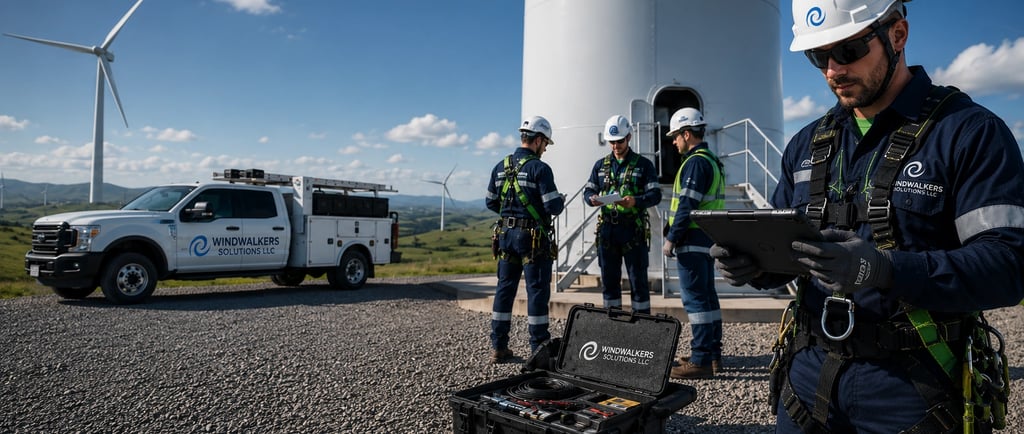
WindWalkers Solutions Technical Methodology
WindWalkers Solutions LLC uses a controlled technical methodology for wind turbine service and wind turbine maintenance. This methodology supports safe field execution, consistent work quality, clear documentation, and long-term asset reliability.
Our technical approach follows a simple WWS field model:
Plan. Verify. Mobilize. Execute. Document. Improve.
1. Scope and Asset Review
Each job begins with a review of the customer request, turbine asset information, site conditions, and required service outcome. WWS confirms the work scope, turbine area, known issues, required tools, PPE, access needs, and applicable customer or OEM requirements before mobilization.
2. Risk and Compliance Screening
Before field work begins, WWS reviews the safety and compliance requirements for the task. This includes OSHA requirements, GWO expectations, site rules, rescue readiness, lockout/tagout needs, fall protection, dropped object prevention, weather conditions, and environmental risks.
No task should begin until the hazards are identified and the required controls are understood.
3. Competency-Based Crew Assignment
WWS assigns field personnel based on verified training, task competency, field readiness, and supervision needs. Crew selection considers technician qualifications, GWO status, task authorization, rescue capability, equipment familiarity, and fitness for duty.
Personnel are assigned based on capability, not availability alone.
4. Pre-Mobilization Preparation
Before traveling to site, WWS prepares the job package. This includes the scope summary, site contact details, tools and equipment, PPE checklist, rescue information, vehicle readiness, job hazard review, inspection forms, and customer reporting requirements.
This ensures crews arrive prepared, aligned, and ready to execute safely.
5. Field Execution and Work Control
Field work is performed under controlled execution standards. The lead technician verifies the scope, hazards, stop-work conditions, rescue plan, and documentation requirements with the crew before work begins.
If site conditions change, the work plan must be reviewed before continuing.
6. Technical Inspection and Maintenance
WWS performs inspection and maintenance activities using consistent technical practices. Work may include tower inspection, blade inspection support, nacelle or hub area checks, fastener and structural observations, corrosion review, damage identification, retrofit support, corrective maintenance support, and post-work quality checks.
Findings are documented with photos, location references, severity notes, and recommended follow-up actions.
7. Quality Verification
Before leaving the work area, WWS verifies that the task is complete, the area is safe, tools and materials are accounted for, required checks are finished, and documentation is accurate. The lead technician or supervisor confirms completion before closeout.
8. Closeout Documentation
WWS closeout records include work performed, personnel involved, site and asset details, hazards controlled, findings, photos, corrective actions, unresolved issues, and required sign-offs.
Clear documentation is treated as proof of professional execution.
9. Continuous Improvement
After each job, WWS reviews field performance, safety observations, documentation quality, customer feedback, and lessons learned. This supports better planning, stronger training, improved procedures, and long-term operational growth.
WWS Technical Methodology Statement
WindWalkers Solutions LLC delivers wind turbine service and wind turbine maintenance through a structured methodology built on planning, risk control, qualified personnel, disciplined field execution, quality verification, and complete documentation. This approach protects workers, supports customer assets, reduces operational risk, and creates a scalable foundation for reliable wind industry service.


© 2026 WindWalkers Solutions LLC. All rights reserved.
Operation
Maintenance Support
Inspection Support
Safety Documentation
Field Reporting
Company
Abous Us
Safety & Quality
Technician Opportunities
Contact
WindWalkers Solutions provides safety-focused wind turbine inspection, maintenance, repair, and retrofit services that help wind energy operators keep their assets reliable, compliant, and field-ready.